

- The pressure difference between discharge side and suction side tank. It is zero for open tanks and closed circulation systems.
- The height difference between the liquid levels of discharge side and suction side tanks respective the system inlet and outlet. It is zero for closed circulation systems.
Total static head
It consists basically of two parts:

 pin, pout= pressures on suction respectively discharge liquid levels ρ = fluid density g = gravity (9.81 m/s2) Hgeo= static height difference between suction and discharge liquid levels Hl,tot= total pipe friction loss between inlet and outlet areas vin, vout= mean flow velocities at inlet and outlet liquid level areas The mean flow velocities at the inlet and outlet areas are, based on the Continuity Law, mostly insignificantly small and can be neglected, if the tank areas being relatively large compared to those of the pipe work. In this case, above formula will be simplified to:
 The static portion of the system H-Q curve, that part that is unrelated to the rate of flow, reads: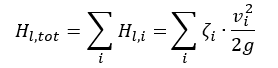
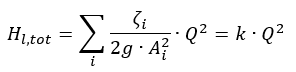 g = gravity (9.81 m/s2) Hl,tot= total friction loss between inlet and outlet areas vi= mean flow velocities trough pipe cross-section area Ai= characteristic pipe cross-sectional area ζi= friction loss coefficient for pipes, fittings, etc. Q = flow rate k = proportionality factor Under the above stated premises the parabolic system H-Q curve can now be drawn:
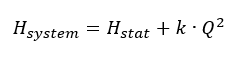 比例系数k的决定specified duty point. The intersection of the system H-Q and the pump H-Q curves defines the actual operating point.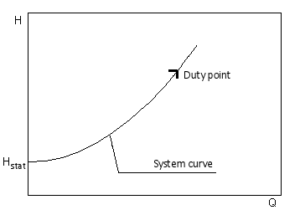

 For closed system installations (e.g. heating or cooling circuits), the geodetic head is zero.